
What Is the Most Effective Way to Study?
As was mentioned, you will only find the most effective study techniques for you by experimenting. It’s not something you try to uncover a few hours before your test. Your goal is to study smarter, not harder. However, be aware that some things that make your study time effective do not involve studying. Here are eight secrets that enable you to study properly.
Be Organized
A wise student is organized. They know when and where their classes are and when all tests, assignments, reports, and any other tasks are due. There are many study planning applications available that can help you organize all this information in one place. If you are old-school, a paper planner will also work. Don’t rely on your memory when you can delegate this task to a planner.
Attend Classes and Pay Attention
If you are in high school or lower, teachers are keener on your attendance than in college or university. However, this is no excuse to miss your classes. You may get the notes later on, but you miss any further explanations your professor may have given. Your planner will help you remember all your classes. However, the task of paying attention is up to you. Stay away from distractions; keep your phone silent and focus on the lecturer. If you have any questions, ask them in class.
Take Notes
Studies show that taking notes helps your brain comprehend the information better. It helps you engage with the information. Some people recommend longhand writing more than typing, but choose whichever is more convenient for you. If you miss part of a lecture, make sure you get the complete notes so that you have everything you need during your next study session.Consult Your Teachers
Many students don’t take advantage of their teacher’s office hours. In higher education institutions, particularly, professors tell their students when they are available for further questions. If you didn’t understand something in class and didn’t have an opportunity to ask, visit the professor later on for clarification. Most educators are more than willing to help you because it shows initiative.
Make a Study Schedule
Don’t save your studying for the night before the test. Spread it out so that you are more relaxed when you do it. Moreover, our brains learn and recall better through repetition. Having a study plan will help you repeat the information several times, which will make it easier to remember it when you need it. In addition to improving recall, study times will reveal what you didn’t understand and give you time to consult with your professors for clarification.
Settle on a Study Space
What kind of environment suits you best? Some people like having background noise while studying, while others prefer silence. This helps you decide between studying at a coffee shop and library. Whatever place you designate, be consistent. It will help your brain associate the place with studying, helping you get into focus much quicker. You can use white noise applications to make your study area more conducive if you can’t find the right study spot.
Study in Sprints
While studying, incorporate breaks. It will allow your brain to consolidate what you have learned so far before you add more information. It may seem counterproductive, but many studies show that taking breaks actually helps you study better.
Study in Groups
Some people find they are more effective when learning in groups, while others thrive when studying alone. However, group study makes you more engaged when studying. You can also help each other understand better because you might find that your study partner understood a part you didn’t. Another way to get the most out of a group study session is to teach what you know.
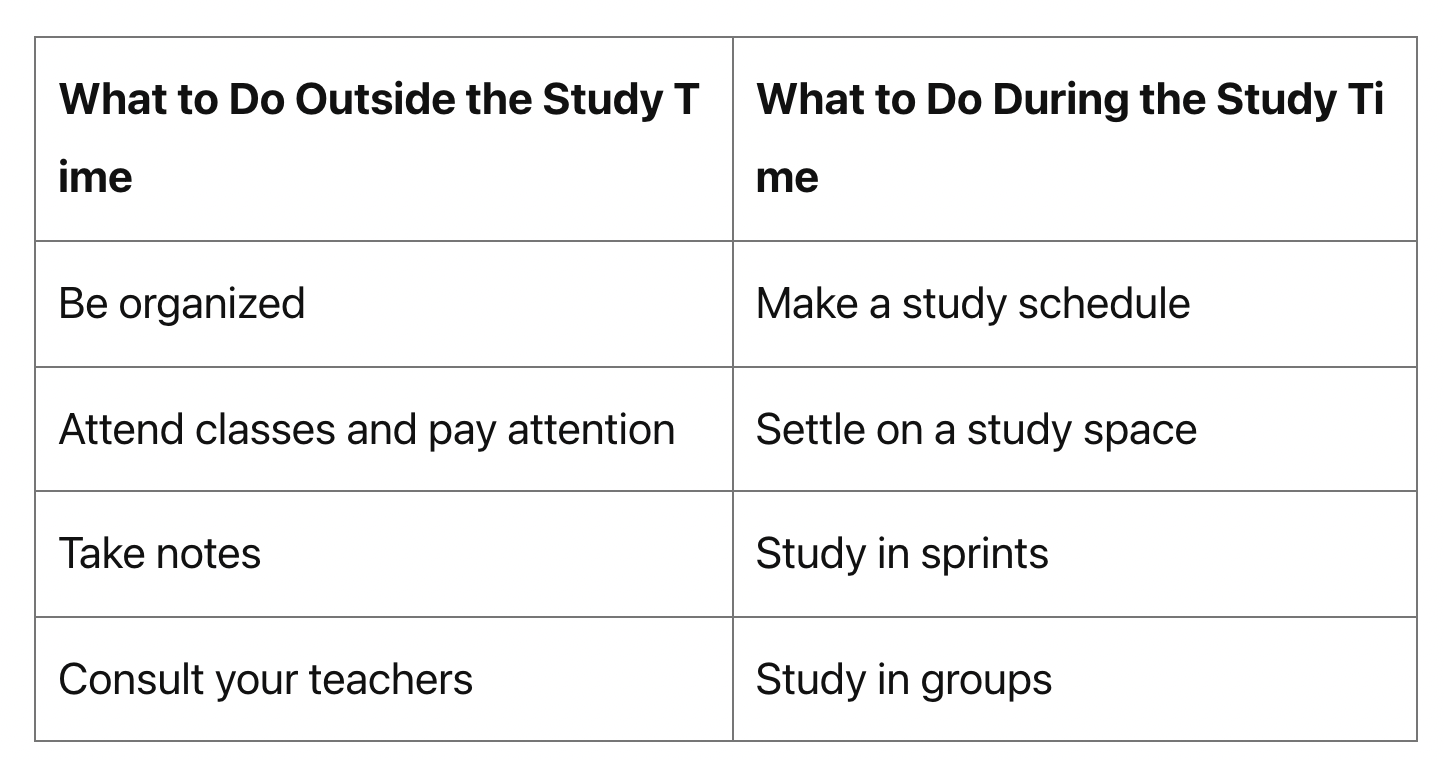
The table below shows the most effective ways to study. It is divided into what to do outside of and during the study session:
What Is the Best Study Method?
After the lecture or class is over, the task of mastering the coursework is usually left to the student. Most students are unaware of what is the best way to study and that there are some scientifically proven methods that are considered effective study techniques. The two evidence-based study techniques highlighted below are far more effective than aimlessly rereading and reviewing your notes.

Spaced Repetition
As was mentioned earlier, we learn by repetition. However, spaced repetition offers a concrete repetition span, which, when followed, makes studying effective. It requires that you review your work at specific intervals over the course of a couple of weeks. People use different periods. One of them is reviewing your work after 1, 7, 18, and 35 days. This is an excellent method to use when preparing for your exams. Furthermore, using spaced repetition will help you recall the work long after the exams.
Practice Testing
Practice testing means trying to recall what you have to learn actively. While most students focus on reading and rereading the content, they don’t test out how well they can remember what they have read. One way to do it is to write down questions you think you may be asked from the notes. After the study session, attempt to answer these questions to see how well you can recall. This takes studying from a passive task to an active task.
How to Study Better – Studying Tips
Once again, your goal is to study smarter, not harder. It means you need to use various methods and tips to help you get the most of your study session in the least time possible. No student wants to spend hours on end every single day studying. Here are fifteen tips that will help you to study better and figure out what is the best way to study for you. They are divided into three – time management tips, study tips, and activities that help your brain.
Time Management Techniques
Here are four time management techniques that will aid your study strategies positively:
The Pomodoro Technique
As was mentioned above, studying in bursts is more effective than having one long singular study session. The Pomodoro technique is designed around this idea. The goal is to study for a set amount of time then take a break. There is a rule book that guides you on how to use the method and how to avoid distractions. Some Pomodoro cycles include the 52:17 and 25:5. The former means you study for 52 minutes and take a 17-minute break. The goal is to do several Pomodoros daily.
The Timeboxing Method
Humans aren’t very good at estimating how much time tasks take. However, the timeboxing method is an excellent way to attempt to map this time out. For example, if you want to study for your exams, you can set (box) a particular amount of time for each topic. If you are writing a scholarship essay, you can use timeboxing by deciding that 2 hours will be spent researching, 1 hour outlining the essay, 3 hours writing it, and 2 hours reviewing and editing. This way, you do not spend too much time on one part at the expense of another. If you understand that you have no enough time for that, or you could not to start writing your essay, you should ask "EssayHub" request at EssayHub essay services.
Eat That Frog
Many times, we know what we are supposed to do; it’s starting that’s the problem. This method requires that you make a to-do list and establish the Most Important Task (MIT). You should then begin your day by working on your MIT. The goal is to work on it before the other distractions of the day take over your time. If you have a problem with procrastination, this method will help you immensely. If your frog is that creative essay, start with it before anything else.
The 10-Minute Rule
You may be wondering what you can get done in 10 minutes. This rule works best as a forcing function. You may feel overwhelmed that you should be studying for the next hour. The task may seem daunting. Tell yourself that you will study just for 10 minutes. Many times, once you have started, you will want to continue. In essence, this is an excellent method to make yourself start.
Study Tips
Some study strategies will help you learn more, faster, and help you enjoy yourself while you do it. The studying tips below are a good arsenal to add to your studying strategies:
Use Mnemonics
If you want to improve your memory, mnemonics are a great way to start. By using rhyming words, keywords, and acronyms to remember large pieces of information, you help yourself increase your odds of remembering. For example, ask many people what the colors of the rainbow are, and they will use the mnemonic ROYGBIV to remember. This mnemonic is taught to young kids but is used even by adults because it is easy to remember.
Use Flashcards
This is a great way to incorporate practice testing into your learning. Flashcards can be used to remember facts and processes equally. They are an excellent way to train your brain to recall information. Using flashcards strengthens memory through repetition.
Use Online Resources
Gone are the days when your teachers were the only sources of information. In this technological age, there are many resources to choose from. You can watch YouTube videos on the same topic taught by another person or other people. You can find notes from other teachers or students online. The point is, technology can help your study better.
Use Technology
There are many ways technology can aid your studying. Time tracking apps will help you track how much time you are spending studying. Planners will help you stay on top of your classes and homework. White noise applications will help you make an environment conducive for your learning. Many people see technology as a distraction, but it all depends on how you use it.
Use Mind Maps
Your brain remembers through association. A mind map is a way to help your brain connect information manually. They are also colorful, which helps make the learning process fun. According to the DoMyEssay service, where you can ask write me an essay "https://domyessay.com", besides making you a better essay writer, mind maps will help you find connections between different topics and subjects.
Outline and Rewrite
One of the reasons students are discouraged from typing notes is that they may end up writing down what the teacher is saying word for word rather than processing the information. If you type, however, you can use your study sessions to write the notes by hand while paraphrasing the notes in your own words. This will help you process the information and understand it better.
Record Your Notes on a Voice Recorder
If you are an auditory learner, you learn best through hearing. By recording your notes, you can play them back at any time. It not only increases the time you can spend learning, but it also makes consequent learning sessions easier.
Minimize Distractions
If you are easily distracted, it may be best to use manual trackers and learning aids and switch off your phone. Otherwise, you can put your phone on airplane mode or do not disturb mode if you really need to use the phone. Some apps also block your access to certain apps and websites for a set time so that you don’t use your phone as a distraction.
To Sum Up
Any student who values their grades but wants to find a balance between their study time and their other activities should consider using effective ways to study. Using effective study strategies will help you save time while simultaneously helping you ace your classes. Take your time to sample different study methods so that you can find the best study strategies that suit your needs.
Remember that you can also always rely on essay writing service and get professional help with your assignments. Save time and improve your grades without effort!
The good news is that there are plenty of effective ways to study, and by using a variety of techniques, you can find the ones that work best for you. We hope this article has given you some ideas for getting started. If you’re looking for more tips, need help in write my paper for me, or a personalized study plan, remember always go to a professional! If you still have questions, let us know how we can assist you in achieving your academic goals! These services like https://www.writemyessay.com/mba-essay-writing-service offer writing solutions that maintain consistency, originality, and academic integrity.